In this lane
- Learn Sides Without Going Flat
- Chunking: Breaking a Scene Into Memorable Pieces
- Write It Out: Why Hand-Copying Sides Still Works
- The Cue-Line Drill
- Run With Gaps: Stress-Testing Your Off-Book
- Learn Sides Overnight Without Losing the Performance
- Off Book Without Sounding Rehearsed
- What to Do After You're Word Perfect
Learn Sides Without Going Flat
A progression for getting off-book and staying alive in the work.
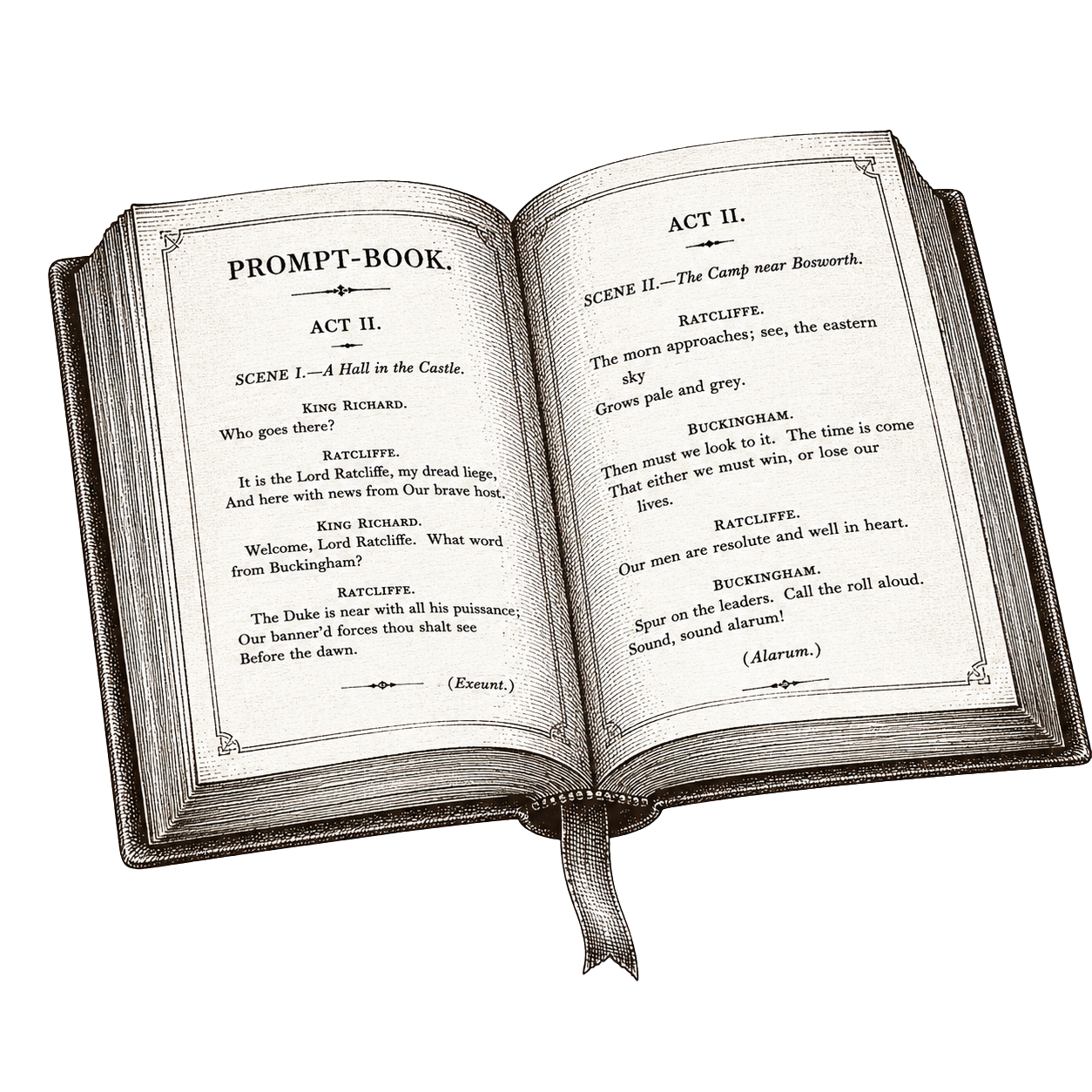
Most of us learn lines the same way we did in school. Read the side. Read it again. Cover the page. Try to say it. Look back when we blank. Repeat until the words mostly stick. By the time we walk into the room, we know the words but the read is dead. The cadence is locked. The character has nowhere to go. The lines came in as text and they come out as text.
There is a better order of operations. Four steps, each doing different work, each leaving the words in a different part of your memory. Working actors reach for some version of this whether they call it by these names or not. The point of naming the steps is that you can tell, mid-prep, which one you have skipped and what is going to fail you in the room.
Why memorizing fails
Memorization fails in three places, not one.
The first failure is the word. You blank on the actual term. Usually a name, a date, a piece of jargon, a phrase that sits sideways in your mouth. You knew it on the couch. You do not know it now.
The second failure is the order. You know the line, but it belongs to a different beat. Sometimes you skip a chunk. Sometimes you say the right thing two pages early. The text is in you but the sequence is loose.
The third failure is the pickup. You know your line cold. You just cannot get to it from theirs. The cue lands and there is a half-second hesitation while you find your way in. On stage that pause is workable. On camera it reads as not-quite-ready.
The four steps below each target a different one of those failures. Run them in order and you walk in covered on all three.
The four steps, in order
1. Chunking
Break the side into pieces small enough to hold. Three to five lines at a time, sometimes fewer, sometimes a single dense run of text. The unit is not the line. The unit is what your working memory can actually carry on one breath of attention.
A chunk is usually a beat. A shift in tactic, a new thought, a new target. If the chunk is not a beat, the chunk is probably too long.
Full piece on chunking.
2. Write it out
Hand-copy the chunk onto paper. Not type. Hand. The act of forming each word forces you to slow down to the speed of language, and the body files the words in a place reading cannot reach. You will catch your own punctuation. You will notice what is repeated, what is reversed, what your character actually says versus what you assumed they said.
Most actors skip this and pay for it under pressure.
Full piece on write it out.
3. Cue-line drill
Take the line that comes right before yours. The cue. Read it, then say your line. Just that pair. Over and over, until the cue triggers the response without thought.
This is the step that fixes the half-second hesitation. Most actors rehearse the run, not the pickup. The pickup is where the read dies.
Full piece on the cue-line drill.
4. Run with gaps
Now you stress-test it. Run the side with deliberate blanks in your lines and try to fill them from memory. The blanks expose the words that are not actually in yet. The ones you have been gliding past on autopilot.
This is what the Memorize game Fill in the Blanks in the app trains directly. Same logic on paper or on screen.
Full piece on running with gaps.
The thing the four steps do together
Chunking gets the material into manageable pieces. Writing locks the exact words. The cue-line drill binds your line to its trigger. The gap run finds what you still do not actually have.
What you end up with is not just memorized lines. You end up with words that are connected to cues, organized into beats, locked at the word level, and tested for soft spots. The text is no longer something you are reciting. It is something you are responding from.
That is the read that does not go flat.
When the audition is tomorrow
There is a faster version of this sequence for one-night turnarounds. Same four steps, compressed, with a specific order of attack so you do not waste hours on the wrong layer. Full piece on learning sides overnight.
What to do once it is in
Word-perfect is the floor, not the ceiling. The work changes the moment the lines are locked. You stop carrying them and start playing them. Full piece on keeping it alive after you are off-book, and on what to rehearse after word-perfect.
Why this order
You can do these four steps in a different order. Most actors stumble onto some version of all four by trial and error over years. The reason to do them in this specific sequence is that each one sets the table for the next.
Chunking decides the unit. The unit is what you write out, drill, and gap-run. If you do not chunk first, the other three steps lose their structure. You end up writing whole pages, drilling random pairs, and gap-running by feel. The work happens but it does not compound.
Writing comes before drilling because the drill needs the exact words to bind to. If your wording is still loose when you start the cue-line drill, you are not binding the cue to a line. You are binding the cue to a moving target.
Drilling comes before the gap run because the gap run tests what you have. If the cue-line pickup is not yet bound, you will fail the gap run for the wrong reason. You will not blank on the word. You will blank because the line never arrived.
In that order, the four steps cover three failures with one pass through the side. Out of order, they cover one failure twice and leave the other two open.
A note on the register
Memorization can feel mechanical because parts of it are mechanical. Chunking is mechanical. Writing it out is mechanical. The drill is mechanical. The point is to do the mechanical work fully, so that when you get to the table the mechanical part is done and you can spend the room on the things that are not mechanical at all.
The actors who sound alive on the day are not the ones who treat memorization as a creative act. They are the ones who treat it as a clean foundation, then build on it.
Start with the chunk.